Our library will be closed from 1 August 2026 to 5 September 2026. We wish all our readers a pleasant summer and a restful holiday!
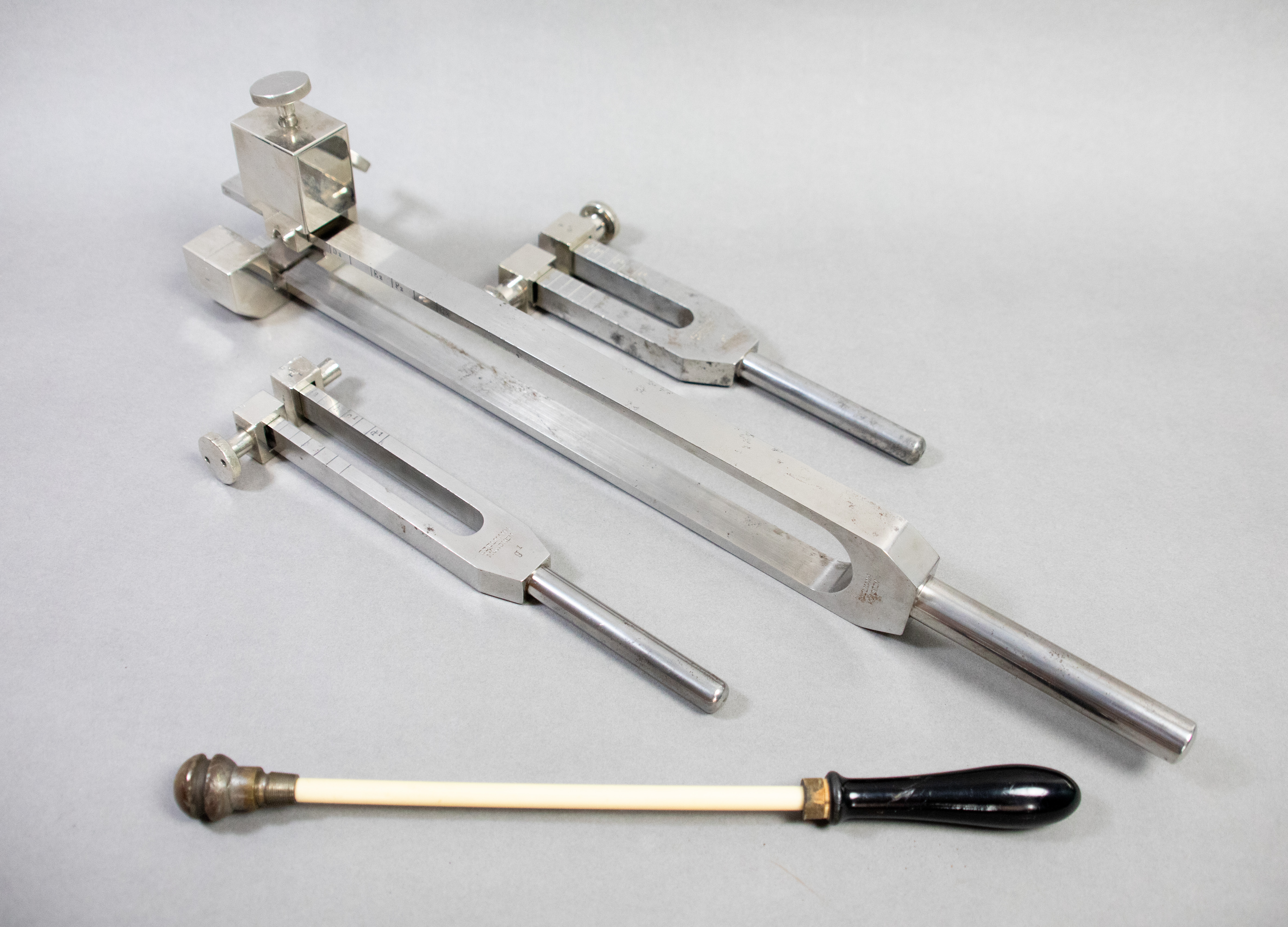
Object of the month – turning fork of dr. Gusztáv Bárczi physician, special education teacher
Dr. Gusztáv Bárczi (Nyitraudvarnok, September 13, 1890 – Budapest, August 9, 1964) was a physician and special education teacher. In 1910 he took the teacher's exam in Léva, in 1913 in Budapest he took the teacher's exam for special education, then in 1921 he obtained a medical degree supplemented with a larynx specialist exam at Pázmány Péter University.
Bárczi initially worked in the Ear, Nose, and Throat Department at János Hospital, led by Dr. Béla Török. He achieved internationally recognized results in the education of Hungarian deaf-mutes*. His hearing testing methods extended to both the ear and the central nervous system's ability to perceive sound. He used whispered speech, conversational speech, and various tuning forks in his examinations. The tuning fork presented in the History of Special Needs Education Collection is one of the tools he used.
Regarding his research conducted with the tuning fork, he wrote: „I surveyed 170 students in our institute, of whom I took regular tuning fork images for 80. The tuning fork images show that the ear should not be banished from the Deaf-Mute Institute.”
Referring to Bezold, he states: „With the achievements of technology, the era will validate him and all those who seek to perfect the education of the deaf-mute through the ear rather than through muscle.”
*based on the language use of that time
Source: The official journal of the National Association of Teachers for the Deaf and Blind, XXX. volume, no. 10, 1928, pp. 172-173.
Written by: Tünde, Bodorné Németh; Éva, Keresztessy; Andrea, Perlusz; Krisztina, Bergmann
Photo by: Gyula, Szaffner
During the autumn break, the opening hours of the ELTE ULA Savaria Library and Archives are as follows:
We wish all our readers a pleasant autumn!
The presentations from the professional day Traditions and Challenges XII. organized by the ELTE University Library and Archives at the end of August, are now accessible online.
The recordings, focusing on topics such as Library Support for Journals and Innovation and Visibility, can be viewed anytime on the Videotorium platform, allowing professional audiences to revisit the full program of the conference.
Object of the month – Plaque of the Comenius University in Bratislava
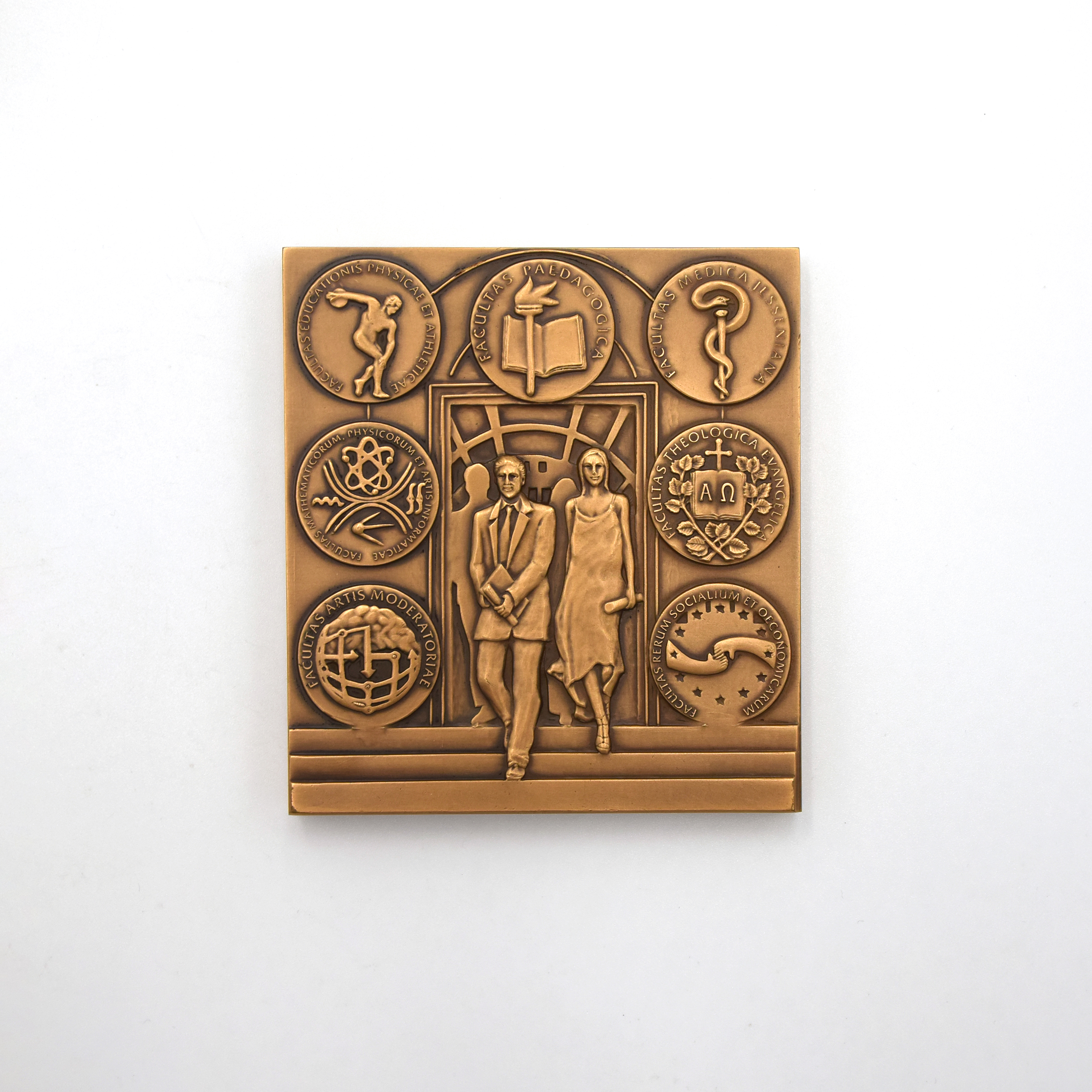
Nearly half of the numismatic material kept in the University Library and Archives - University History Collection are commemorative medals and plaques that our institution received as gifts from partner universities. The plaque made for the 90th anniversary of the founding of the Comenius University in Bratislava, chosen as the artifact of the month, was presented to ELTE for the 375th anniversary of the founding of the Eötvös Loránd University.
The base of both sides of the plaque is an arched door with a flight of steps. Three round pendants were placed on each side of the doors, and one round pendant above them. The coat of arms of the Comenius University can be seen in the main place of the front side, in a larger circle than the others, which depicts the bust of Comenius. The other pendants display the Latin names and symbols or coats of arms of the thirteen faculties of the university. The inscription on the front door reads: "90 UK", which briefly refers to the abbreviation of the Slovak name of the university founded in 1919 (University Komenského v Bratislave) and its age. A young woman and a man can be seen in the door on the back side, each holding a rolled-up document.
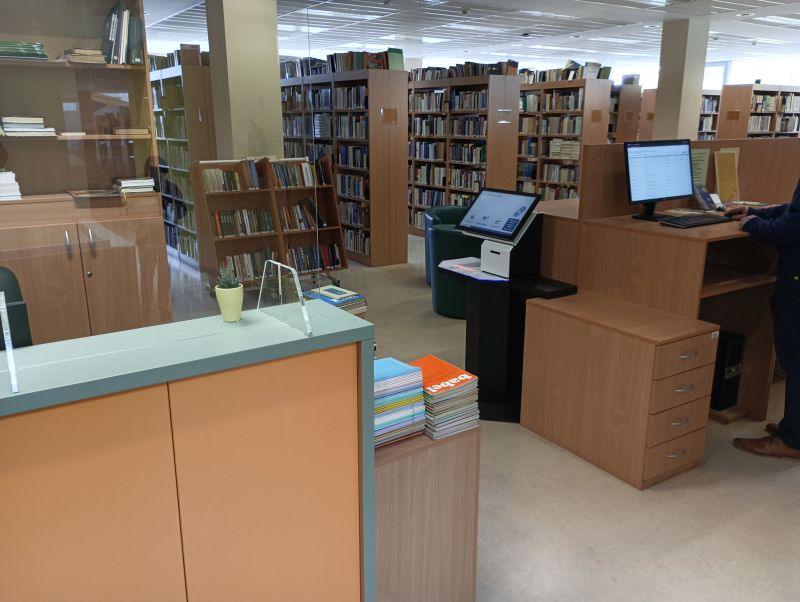
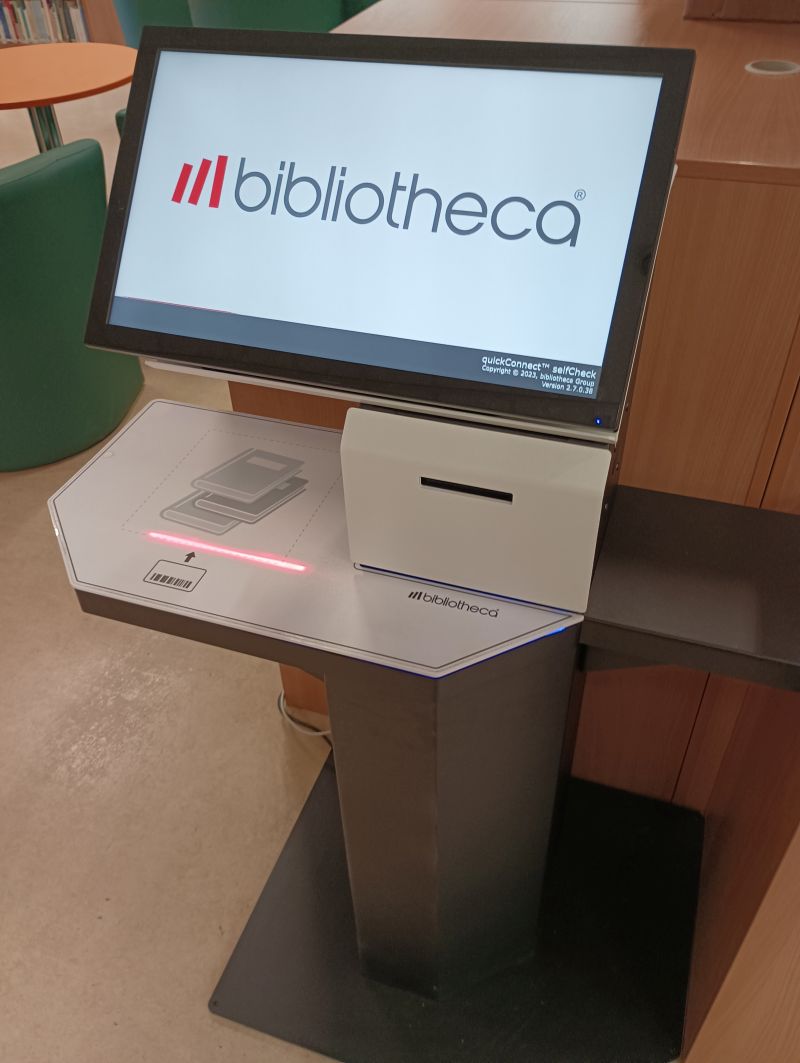
A new RFID (Radio Frequency Identification) self-checkout terminal has been introduced at the ELTE ULA Savaria Library and Archives, making the borrowing process even faster and more convenient.
With the new system, readers can independently borrow books without the direct involvement of librarians. All they need to do is place the RFID-tagged books on the terminal, and after identification, they can complete the borrowing in just a few simple steps. This system not only speeds up the process but also ensures a more secure borrowing experience.
The self-checkout terminal is easy to use, and our library staff are happy to assist with any questions. This new service further enhances our library’s commitment to offering modern, user-friendly solutions to our visitors.
We warmly invite you to come and try out the new system!
The Museum of Fine Arts opened the Kingdom of Gods and Demons. Mesopotamia 1000–500 BC on 5 October 2024, an exhibition that explores the ancient Mesopotamian heritage and culture that was the cradle of civilisation. More than 150 artefacts, including volumes from the ELTE University Library and Archives, will give visitors a glimpse into the lost world of the Bible and, indirectly, the origins of European culture.
In addition to three special publications from our library's collection, The monuments of Nineveh by Austen Henry Layard , Victor Place Nineveh et l'Assyrie, and Monument de Nineveh by Paul-Émile Botta and Eugène Flandin, the exhibition brings together treasures from major European public collections, including the Vorderasiatisches Museum, Berlin; the Bibliothèque nationale de France and the Musée du Louvre, Paris; and the Kunsthistorisches Museum, Vienna. The exhibition, which was made possible with the professional collaboration of the MTA – ELTE Assyrian and Babylonian God World Research Group, will be open until 2 February 2025.
ELTE has been granted one month trial access to CNKI's new artificial intelligence-based research tools, CNKI Smart and Scite.
ACCESS PERIOD: OCTOBER 9, 2024 - NOVEMBER 9, 2024
CNKI Smart uses artificial intelligence language models built on CNKI's own massive databases to help users perform quick and efficient literature reviews, analysis and article writing, while ensuring content authenticity, information reliability and credibility.
Scite is a product of Research Solutions, with which CNKI works closely and which has enabled it to incorporate this tool into its services. Scite is an artificial intelligence-based citation analysis tool that helps researchers to better discover and evaluate scientific articles. It uses a tool called Smart Citation to visualise the context of a citation and analyse whether the article supports, contradicts or just mentions the cited passage as evidence.
The databases are accessible from the university or from home:
FROM THE ENTIRE IP RANGE OF ELTE;
IN ADDITION TO IP BASED DETECTION,
USING CNKI SMART REQUIRES A SEPARATE REGISTRATION ON THE WEBSITE!
(YOU CAN REGISTER WITH ANY EMAIL ADDRESS,
NOT ONLY WITH YOUR ELTE INSTITUTIONAL ACCOUNT.)
ACCESS FROM UNIVERSITY GROUNDS
ACCESS FROM HOME
We are bidding farewell to our premises on Maglódi út. The archives will be closed from 14 October 2024 for the duration of the move.
We will not be available in person or by telephone, and will only be able to respond to enquiries sent to inf@leveltar.elte.hu. The archives are expected to open in early January 2025. The exact date and details will be announced later. We than our researchers and customers for their patience, understanding and support!
ELTE has been granted trial access to two databases of the Korean Nurimedia, DBpia and KRpia.
The databases are available in the entire IP range of ELTE.
ACCESS PERIOD: OCTOBER 1, 2024 - JANUARY 5, 2025
DBpia is an academic information portal where you can search domestic journals and dissertations. They provide full-text service of 2,300 types of academic journals and 2.3 million academic papers issued by outstanding Korean academic societies and publishers.
KRpia is Korea's best integrated knowledge content service that includes books, documents, complete collections, databases, dictionaries, and multimedia.